
 Türkçe
 German
 Spanish
 Russian
 Italian
Obesity
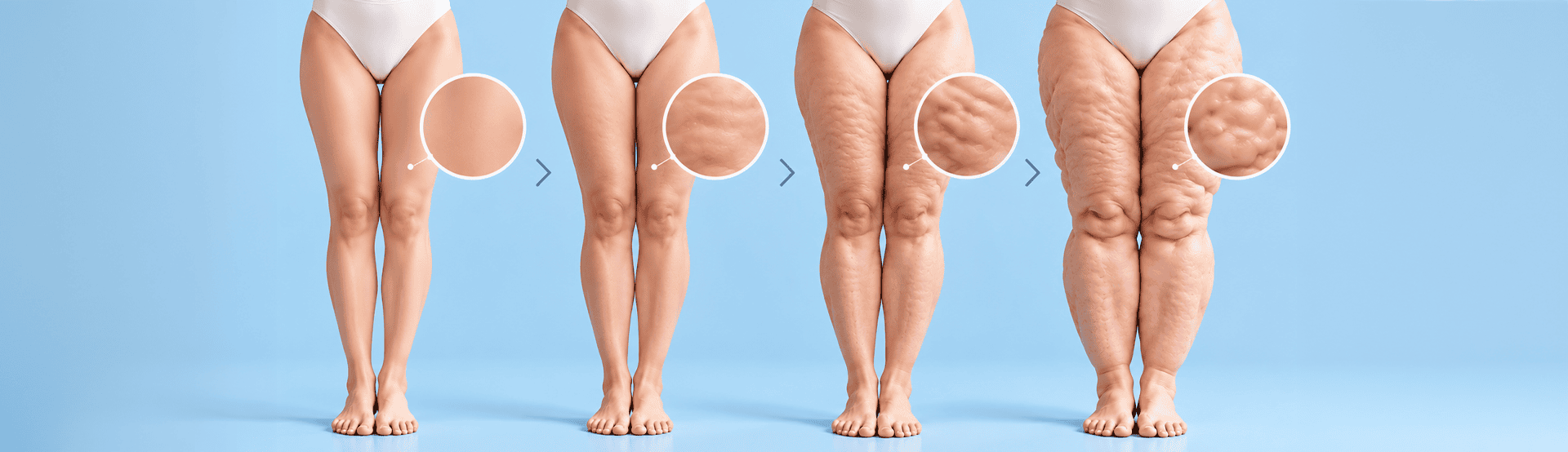
Lipedema Stages 1, 2 and 3: What Your Stage Means
Understanding lipedema stages is genuinely useful, but there is one point that is widely misunderstood online, and it changes how you should read everything else:
Lipedema stages describe how your skin and fatty tissue look and feel. They do not measure how much pain you have, how much the condition limits your life, or whether you need surgery.
The 2026 Lipedema World Alliance consensus, published in Nature Communications, makes this explicit: 95% of the expert panel agreed that staging does not reflect the full severity of symptoms, and 92% agreed that the current stages have limited relevance for disease management. The 2024 German S2k lipedema guideline goes further and states that stages should not be used to measure severity at all.
In this guide you will find:
- A clear description of stage 1, stage 2 and stage 3 lipedema, with a comparison table
- The truth about "stage 4" and lipolymphedema
- The difference between lipedema stages and lipedema types
- New 2026 trial data showing how surgery results compare across stages
- A simple framework to describe your own lipedema more accurately than a stage number ever could
What Are the Stages of Lipedema?
Lipedema is a chronic condition in which painful fatty tissue builds up symmetrically in the limbs, while the hands, feet and trunk are typically spared. It affects almost exclusively women and often begins or worsens around hormonal changes such as puberty, pregnancy or menopause.
The traditional classification divides lipedema into three stages based on morphology, meaning the visible and palpable changes in the skin and subcutaneous tissue. The Lipedema Foundation summarizes them as follows:
- Stage 1: smooth skin with an increase of enlarged subcutaneous fat tissue
- Stage 2: an uneven skin surface with indentations, dimpling or a wavy "orange peel" texture
- Stage 3: large extrusions of fat tissue, lobules or overhangs of fat causing deformations
Lipedema Stages at a Glance
Notice that pain is described the same way in every column. That is deliberate. Current evidence does not support labeling stage 1 as "mild pain" and stage 3 as "severe pain".
Stage 1 Lipedema: Smooth Skin, Real Symptoms
Stage 1 is the earliest morphological presentation of lipedema, and it is also the hardest to recognize. Because the skin still looks smooth, many women are told they simply have a pear shaped figure, or that they need to lose weight. According to the Lipedema Foundation, the fat in stage 1 is often soft, although small nodules can sometimes already be felt beneath the skin.
What Stage 1 Lipedema Looks Like
Possible visible features of early stage lipedema include:
- Hips, buttocks or legs that are clearly larger than the upper body
- Symmetrical enlargement of both legs
- Fat pads on the inner side of the knees
- Thickening of the lower legs, sometimes ending abruptly above the ankle in a "cuff"
- A relatively smooth skin surface
- Feet that remain slim compared with the legs
Stage 1 Lipedema Symptoms
Even with smooth skin, symptoms can be very real:
- Tenderness and sensitivity to pressure
- Aching or heavy legs, especially by the evening
- Easy bruising, sometimes without remembering any knock
- Discomfort after standing or walking for long periods
- Legs that stay disproportionate even after weight loss
The 2026 consensus describes untreated lipedema as a symmetrical, bilateral enlargement of subcutaneous fat accompanied by pain or discomfort, and the German guideline considers pain part of the definition. Disproportionate fat without pain is classified as lipohypertrophy, not lipedema. So a stage 1 diagnosis already implies symptoms, and stage 1 does not mean mild lipedema. Someone with smooth skin can still live with significant pain, reduced mobility and emotional distress.
Stage 1 Lipedema Treatment Options
Treatment at this stage should follow your symptoms rather than the number. The consensus recommends conservative care built on:
- Compression: flat knit garments are commonly used to ease heaviness and discomfort. Compression manages symptoms; it does not dissolve lipedema fat.
- Exercise: walking, yoga and exercise in water are specifically mentioned in the consensus. Water supports body weight and gently compresses the legs, which many patients find comfortable.
- Nutrition and weight management: to protect metabolic health and prevent coexisting obesity, not to "diet away" lipedema tissue.
- Education and self management: active self management was supported by 92% of the expert panel as a way to control symptoms and improve quality of life.
Manual lymphatic drainage may be included when swelling is present, but the consensus also notes that not every component of decongestive therapy is needed for every patient.
Stage 2 Lipedema: When Texture Changes
In stage 2 lipedema, changes in the tissue become easier to see and feel. The surface of the skin is no longer completely smooth, and the fat underneath often becomes thicker and firmer. The UK charity Lipoedema UK describes nodules in this stage ranging from the size of a walnut to the size of an apple.
What Stage 2 Lipedema Looks Like
Typical changes include:
- Dimpling and waviness: an "orange peel" or mattress like surface that can resemble cellulite, although the two are different conditions
- Larger nodules: lumps under the skin become easier to feel
- Firmer tissue: increasing fibrosis makes the fat feel less soft
- Clearer disproportion: the contrast between the upper and lower body becomes more obvious
- Inner knee deposits: fat pads around the knees become more prominent
Stage 2 Lipedema Symptoms
Common complaints include tenderness, pain, bruising, heavy legs, discomfort during longer activity and difficulty finding clothes that fit both the waist and the legs. Yet stage 2 does not mean symptoms are twice as bad as in stage 1. The consensus agreed (95%) that progression in severity is not universal: some women worsen, others remain stable, and many fluctuate.
Stage 2 Lipedema Treatment Options
Stage 2 management builds on the same foundations as stage 1, adapted to the tissue changes and your symptoms:
- Well fitted compression, reviewed as limb shape changes
- Individualized exercise, including strength work to support the knees
- Nutritional and metabolic health support
- Weight optimization if obesity is also present
- Physiotherapy and selected parts of complex decongestive therapy
- Pain and mobility management
- Assessment for surgery in selected patients with persistent symptoms
Can stage 2 lipedema be treated with liposuction? Potentially, but stage 2 alone is not an indication. The consensus recommends considering lymph vessel sparing lipedema reduction surgery when there is potential for a positive impact on symptoms. The question is never "Am I stage 2?" but "Is surgery likely to improve my symptoms at an acceptable level of risk?"
Stage 3 Lipedema: Lobules and Overhangs
Stage 3 is the most advanced category in the traditional three stage system. According to the Lipedema Foundation, it involves large extrusions or overhangs of fatty tissue causing deformations, with nodularity and fibrosis being very common. Lobules typically form around the thighs and knees.
What Stage 3 Lipedema Looks Like
Possible features include:
- Large lobules and folds of fat, especially on the thighs
- Pronounced deposits on the inner knees
- Significant contour irregularities and fibrotic tissue
- Numerous, often large, nodules
- A mechanical change in leg shape
These changes can interfere with movement in practical ways: an altered walking pattern, skin rubbing against skin, difficulty crossing the legs, and extra strain on knees and hips.
Is Stage 3 Lipedema Always More Painful?
No. It seems logical to assume a simple ladder of mild, moderate and severe, but lipedema does not work that way. One woman with stage 1 tissue may have intense pressure pain, while another with stage 3 tissue may be troubled mainly by mechanical limitations rather than pain.
Stage 3 Lipedema Treatment Options
Stage 3 usually calls for careful, multidisciplinary planning because several issues may overlap:
- Compression adapted to the limb shape
- Exercise matched to current mobility
- Weight and metabolic health
- Joint and musculoskeletal problems
- Skin care in folds, where friction and moisture can irritate the skin
- Lymphatic assessment if swelling is present
- Psychological and social support
- Surgery when clinically appropriate
Stage 3 does not automatically mean surgery. It describes morphology, not a mandatory treatment pathway. Where surgery is considered, it should be performed by clinicians with extensive experience in lipedema and integrated with conservative care, as the consensus recommends with 98% agreement.
Is There a Stage 4 Lipedema?
You will often see "stage 4 lipedema" mentioned online. Some older systems used this label for lipedema combined with lymphedema, a combination usually called lipolymphedema.
The Lipedema Foundation no longer uses the stage 4 designation, and for a good reason: lymphedema can be present at any stage of lipedema. Calling it stage 4 wrongly suggests that every woman passes through stages 1, 2 and 3 before her lymphatic system is affected. It is clearer to describe both conditions separately:
- Lipedema: the stage and the distribution of the fatty tissue
- Lymphedema, if present: swelling caused by impaired lymphatic drainage, often involving the feet
A simple clinical clue helps here. In pure lipedema, the Stemmer sign (the ability to pinch and lift a fold of skin at the base of the second toe) is usually negative. A positive Stemmer sign suggests lymphedema and warrants further assessment.
Lipedema Types: Where the Fat Sits
Stages and types are frequently confused, yet they answer different questions. The stage describes what the tissue looks and feels like. The type describes where it is located. Lipoedema UK lists five types:
- Type 1: pelvis, buttocks and hips, often called the "saddlebag" pattern
- Type 2: buttocks to knees, with folds of fat around the inner knees
- Type 3: buttocks to ankles
- Type 4: arms
- Type 5: lower legs only
Types can combine, and arm involvement is common: the Lipedema Foundation reports that nearly 80% of women with lipedema also have fat on their upper limbs. A woman can therefore have stage 2 tissue in a type 3 pattern with arm involvement. Stage and type sit side by side; neither replaces the other.
Your Stage Is Not Your Pain Level
This is the most important point in any discussion of lipedema stages, and in 2026 it is finally supported by randomized data.
The LIPLEG trial, published in The Lancet in September 2026, randomized 410 women with stage 1, 2 or 3 lipedema to liposuction or continued conservative therapy. All participants already had leg pain of at least 4 out of 10 before treatment. At 12 months, the share of patients whose pain fell by at least 2 points after liposuction was remarkably similar across stages:
- Stage 1: about 68%
- Stage 2: about 73%
- Stage 3: about 65%
With conservative therapy alone, only around 7% to 10% reached the same improvement, whatever the stage. In other words, women in stage 1 had as much pain to begin with, and gained as much from treatment, as women in stage 3.
Why Stage 3 Became the "Surgery Stage"
Many patients still believe they must "reach stage 3" before surgery is possible. That idea did not come from biology. It came largely from insurance rules.
In Germany, where much of the lipedema research is done, statutory health insurance began paying for liposuction in 2020 only for stage 3, as a temporary arrangement while the LIPLEG trial was running. Clinics, patients and online forums came to treat stage 3 as the threshold. Once the trial data were available, Germany's Federal Joint Committee decided in 2025 to extend coverage to all stages, subject to conditions such as stable weight and six months of consistent conservative therapy.
There is also evidence that waiting may not help. In a 2022 study of 106 patients who underwent 298 liposuction procedures, the reduction in the need for decongestive therapy after surgery was significantly greater in stages 1 and 2 than in stage 3. So if your symptoms are significant, there is no medical reason to wait for your tissue to look worse before seeking assessment.
Does Lipedema Always Progress?
No. Lipedema is chronic, but it is not categorically progressive. The German guideline states this directly, and Lipoedema UK notes that lipedema is not automatically progressive. Some women move from stage 1 to stage 2 or 3; many remain stable for years or experience fluctuating symptoms.
Factors that may influence the course include:
- Individual and genetic predisposition
- Hormonal changes such as puberty, pregnancy and menopause
- Weight gain and coexisting obesity
- Reduced mobility
- Other medical conditions
Research into why some women progress and others do not is ongoing, and all experts in the consensus agreed that the underlying biology still needs to be clarified.
Can Weight Gain Make Lipedema Worse?
Lipedema and obesity are separate conditions, but they often coexist, and the consensus agrees that obesity worsens the manifestations of lipedema. Excess body weight can mean greater limb volume, more strain on the joints, reduced mobility, higher surgical risk and more difficulty telling lipedema tissue apart from general fat. This does not mean lipedema is caused by being overweight, nor that every woman with lipedema needs to lose weight. It means both conditions should be assessed and managed on their own terms.
Can Diet Reverse Lipedema Stages?
There is currently no evidence that any diet can turn stage 3 tissue back into stage 1. The consensus describes lipedema fat as largely resistant to dietary interventions, while still recommending nutritional guidance for metabolic health, weight management and overall wellbeing. Be cautious with any food, supplement or short program that claims to cure lipedema. According to the consensus, there is currently no evidence that any medication treats lipedema itself.
What Stage of Lipedema Do I Have?
Comparing yourself with photos online is tempting, but staging should be part of a proper clinical examination. Lipedema is a clinical diagnosis: no blood test or scan confirms it, although ultrasound and laboratory tests help exclude other conditions. During an assessment, a clinician may look at:
- Skin and tissue texture, nodularity and fibrosis
- Overhangs, symmetry and fat distribution
- Which areas are affected, including the arms
- Pain, tenderness and bruising
- Swelling, foot involvement and the Stemmer sign
- Signs of lymphedema, venous disease, obesity or thyroid problems
Interestingly, the German guideline advises against using the "lumpy" feel of the tissue as a diagnostic criterion on its own. Nodules can help describe the stage, but they do not prove the diagnosis.
Map Your Lipedema Profile
Because a single stage number says so little, it helps to describe your lipedema in three parts. This gives you and your clinician a far more accurate picture, and it lets you track change over time.
- Stage (texture): smooth, dimpled or lobular? This is your morphological stage.
- Type (location): hips only, down to the knees, down to the ankles, lower legs, arms?
- Impact (symptoms): rate pain, heaviness and pressure sensitivity from 0 to 10, and note what you can no longer do comfortably, such as walking a certain distance or climbing stairs.
For example, "stage 1, type 3 with arms, pain 7 out of 10, cannot walk more than 20 minutes" tells a clinician much more than "stage 1" alone. Repeat your impact scores every few months and bring photos taken in the same light and position. If your scores change, that matters more than whether your stage number does.
Lipedema Treatment by Stage
Treatment is chosen according to the whole patient. Here is how the main options typically relate to the stages:
- Compression: useful at every stage for symptom control, with garments adapted as limb shape changes
- Exercise: important at every stage; in stage 3 it is adapted to mobility and joint health
- Nutrition and weight management: relevant at every stage, especially when obesity coexists
- Decongestive therapy: can be effective even in early stage lipedema, according to the consensus, but not every component is needed for every patient
- Psychological support: recommended at every stage, since body image and mental wellbeing are often affected
- Lymph sparing liposuction: considered at any stage when symptoms persist and meaningful improvement is likely, not when a certain number is reached
Lipedema Stages FAQ
What are the 3 stages of lipedema?
Stage 1 involves enlarged fatty tissue with a smooth skin surface. Stage 2 involves uneven, dimpled skin, larger nodules and increasing fibrosis. Stage 3 involves large lobules and overhangs of fat that change the contour of the legs.
Can stage 1 lipedema be painful?
Yes. Pain and tenderness are part of the condition at every stage. An early stage does not mean mild symptoms.
Does stage 1 always progress to stage 3?
No. Progression is not universal. Some women experience worsening tissue changes, while others remain stable or fluctuate over time.
Is stage 3 lipedema always painful?
No. Pain severity does not match the stage. Some women with stage 3 tissue are troubled mainly by mechanical problems, while some in stage 1 have intense pain.
Can stage 2 lipedema be treated without surgery?
Yes. Compression, exercise, nutrition and other conservative therapies can manage symptoms. Surgery is considered only when symptoms persist and improvement is likely.
Does stage 3 lipedema require liposuction?
Not necessarily. Surgery depends on symptoms, function, general health and expected benefit, not on the stage number.
Is there a stage 4 lipedema?
Some older systems used stage 4 for lipedema with lymphedema. The Lipedema Foundation no longer uses this label, because lymphedema can occur at any stage. The combination is called lipolymphedema.
Can I find my lipedema stage from photos?
Photos can show proportions and visible texture, but they cannot assess tenderness, fibrosis or swelling, or exclude similar conditions. A clinical examination is needed.
Get an Individual Lipedema Assessment
Your stage describes the texture of your tissue. It is useful information, but it should never become your whole diagnosis. Two women with the same stage can have completely different experiences: one may feel little discomfort, while the other struggles with pain, bruising and limited mobility every day.
That is why a proper lipedema assessment looks at the full picture:
- Your symptoms and how they affect daily life
- Your tissue characteristics and stage
- Your distribution pattern and type
- Your general and metabolic health
- Your personal treatment goals
At Best Self Club, every lipedema journey begins with an individual medical assessment based on your symptoms, medical history, photographs and goals. Where appropriate, our medical team can then advise whether conservative management, further diagnostic tests or lipedema reduction surgery is the right next step.
Request a lipedema assessment to understand your stage, your symptoms and the treatment options available to you.
This article is for general educational purposes and does not replace an examination, diagnosis or individual medical advice from a qualified healthcare professional.
