 Türkçe
 German
 Spanish
 Russian
 Italian
Plastic Surgery
The Complete Guide to Fat Grafting
Unlike synthetic fillers or implants, the material being transferred is entirely the patient's own tissue, which makes it one of the most natural and biocompatible options in aesthetic medicine today. When transferred fat successfully integrates and develops its own blood supply, results can be genuinely long lasting, and in some areas, permanent.
The technique also comes with a built in dual benefit. Fat is removed through mini liposuction from an area a patient wants slimmer, then added to an area they want fuller, addressing two goals in a single procedure.
What Is Fat Grafting?
At its core, fat grafting relocates living tissue rather than introducing a foreign material into the body. Because the graft is made of the patient's own cells, there is no risk of the kind of rejection seen with implants, and the result tends to move, feel, and age like natural tissue because it is natural tissue.
How the Fat Grafting Procedure Works
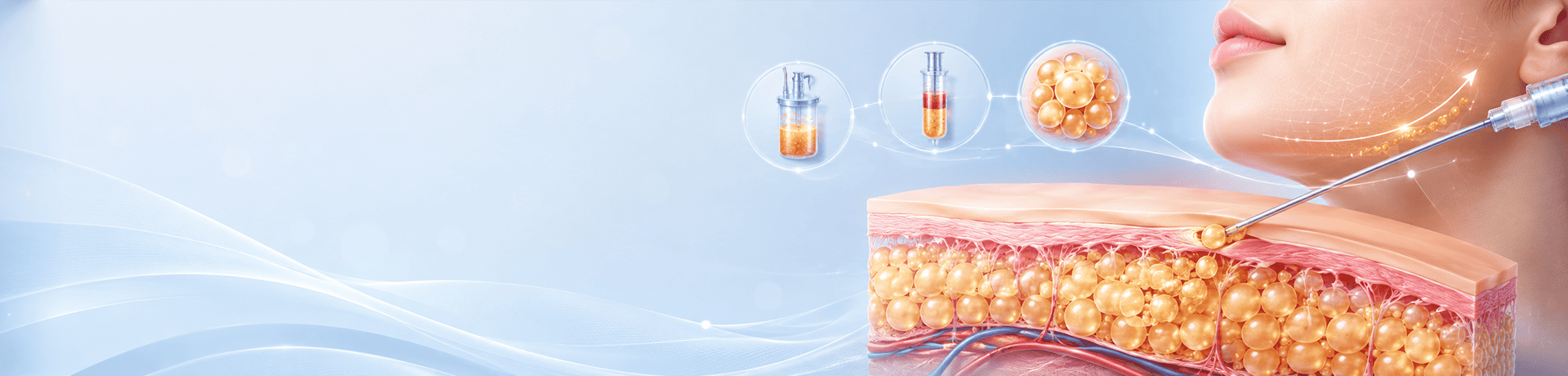
Fat grafting happens in three distinct stages, and how carefully each one is performed has a direct effect on how much of the transferred fat ultimately survives.
Stage one, harvest. A thin cannula is inserted through a tiny incision into a donor site, typically the abdomen, flanks, thighs, or inner knees. Fat is removed using gentle, low pressure suction to limit cell damage. The gentler the harvest, the more viable cells make it through to the next stage.
Stage two, processing. What comes out of the body during harvest is a mixture of fat cells, blood, oil from ruptured cells, and fluid. This mixture is processed, usually through centrifugation or careful decantation, to isolate the purest layer of usable fat. Spinning or processing too aggressively damages cells and lowers survival rates, so this step requires real technical care.
Stage three, micro injection. Purified fat is loaded into small syringes and reinjected using a blunt cannula. The guiding principle here is micro droplet placement. Fat needs to be deposited in tiny parcels, each one close enough to well vascularized tissue to develop a new blood supply within roughly two millimeters. Injecting too much in a single pass creates pools of fat that cannot receive enough oxygen, and that fat dies and is reabsorbed rather than surviving as permanent tissue.
Fat Grafting for the Face
Facial aging is driven largely by volume loss, not just loose skin, which is why fat grafting addresses a root cause of aging rather than simply tightening the surface. Here is how it applies across different areas of the face.
Under eyes, or tear trough. This is one of the most requested areas and also one of the most technically demanding, since there is almost no cushioning tissue between skin and bone in this region. Surgeons typically use nano fat or emulsified fat, injected in very small amounts and placed superficially. Overcorrection is immediately noticeable here, so a conservative approach and a genuinely experienced surgeon both matter enormously.
Cheeks and midface. This tends to be one of the most rewarding areas for fat grafting. Restoring volume here lifts the entire midface, softening nasolabial folds, restoring cheekbone projection, and brightening the under eye area all at once. Surgeons commonly use somewhere in the range of 5 to 12 milliliters per side, injected across multiple tissue planes to create a natural, three dimensional result.
Temples. Temporal hollowing is a common but often overlooked sign of facial aging. Fat grafting here helps frame the face and supports a youthful oval shape. Because this area experiences little movement and has a good blood supply, it tends to hold onto transferred fat relatively well.
Lips and the perioral area. Fat grafting to the lips generally produces a softer, more natural look than hyaluronic acid filler, which makes it a good fit for patients who want fullness rather than sharp definition. Nano fat can also help soften fine lines around the mouth, marionette lines, and the corners of the lips.
Jawline and chin. Fat can add subtle projection to a receding chin, soften jowl shadows, or refine the lower face without the use of implants.
Combining fat grafting with facial surgery. Fat grafting is frequently paired with facelifts, blepharoplasty, and rhinoplasty. A facelift that repositions tissue without also restoring lost volume can leave a pulled rather than rejuvenated look, and adding fat helps the result read as naturally refreshed instead of surgically altered.
Fat Grafting for the Eyes and Under Eyes
The periorbital area deserves its own discussion, since it is one of the most frequently searched topics in aesthetic medicine and also one of the most misunderstood.
The tear trough hollow develops as the fat pad beneath the eye shifts and descends with age, creating a shadow that can make someone look tired regardless of how well rested they actually are. Fat grafting is one of the most effective and durable solutions for this, though it genuinely requires a surgeon who specializes in this specific area.
A few things make periorbital fat grafting different from fat grafting elsewhere on the face:
- Only nano fat or microfat should be used, since standard fat parcels are too large for this delicate area
- Volumes are extremely small, often under one milliliter per side
- Placement has to be precise to avoid visible lumps or a puffy appearance
- The vascular anatomy around the eye requires careful, deliberate technique
- More than one session is sometimes needed for full correction
The upper eyelid hollow, known as the superior sulcus, can also be treated this way, restoring fullness that is often lost with age and that can make the upper lid look deeply creased or hollow. It is also worth knowing that many patients considering lower blepharoplasty, the surgical removal of under eye bags, may actually be better served by fat grafting into the hollow beneath the eye rather than removing tissue. A good surgeon should walk through both options honestly before recommending either one.
Brazilian Butt Lift: Fat Grafting to the Body
The Brazilian Butt Lift, or BBL, is one of the most requested body contouring procedures in the world, combining targeted liposuction with fat transfer to the buttocks to reshape the entire lower body silhouette.
What makes it unique. The procedure's effect comes from working in two directions at once. Removing fat from the waist, flanks, lower back, and thighs creates contour before any fat even reaches the buttocks, and that interplay between subtraction and addition is what produces the dramatic waist to hip ratio the BBL is known for.
Classic BBL versus Micro BBL. A classic BBL typically involves liposuction around the trunk and the transfer of larger volumes, often somewhere between 600 and 1500 milliliters per side, distributed across the upper, mid, and lower buttock. A Micro BBL uses smaller volumes for patients who want subtle shaping rather than dramatic augmentation, generally with a shorter recovery.
Hip dips. Correction of the lateral hip indentations often referred to as hip dips is a common add on request. Fat grafting tends to work well here and holds up reliably over time, since this area experiences relatively little movement.
BBL Safety: What Changed and Why It Matters
The BBL has historically carried a higher complication profile than most other aesthetic procedures, largely due to the risk of fat embolism when fat is injected too deeply and enters the gluteal blood vessels.
In January 2018, a multi society task force representing several major plastic surgery organizations reviewed a series of BBL related deaths and found a consistent pattern. In nearly every fatal case, fat had been placed within or beneath the gluteal muscle, where large veins run, rather than staying above it. Based on those findings, the task force recommended that fat be injected only into the subcutaneous space, above the gluteal muscle fascia, using blunt cannulas and careful, deliberate technique.
The impact of that shift has been significant. Follow up surveys tracking surgeon practices found that BBL mortality rates dropped considerably in the years after the new guidelines were adopted, from roughly one in three thousand procedures in 2017 to closer to one in fifteen thousand a few years later, alongside a sharp increase in the share of surgeons who reported following subcutaneous only technique. At Best Self Club, we follow current evidence based safety guidelines and walk through the full risk and benefit profile with every patient at consultation.
What to do after a BBL. Following post operative instructions closely has a direct effect on how much of the transferred fat ultimately survives:
- Avoid sitting directly on the buttocks for roughly four to six weeks, using a BBL pillow under the thighs instead
- Sleep on your stomach or side for the same period
- Wear compression garments for around 22 to 23 hours a day for six to eight weeks
- Avoid strenuous lower body exercise for at least eight weeks
- Keep your body weight stable during the healing period
- Do not smoke, since smoking meaningfully impairs the new blood vessel growth that fat survival depends on
Why Transferred Fat Reabsorbs
This is probably the question patients ask most often, and the answer involves biology, anatomy, and surgical skill in roughly equal parts.
Transferred fat arrives at its new location without a blood supply of its own. For the first two to three days, fat cells survive on oxygen and nutrients diffusing in from the surrounding tissue, a process called plasmatic imbibition. During this window, new blood vessels begin growing into the graft. Fat cells that successfully connect to this new vascular network go on to survive permanently, while cells that do not receive enough oxygen undergo programmed cell death and are gradually cleared by the body over the following weeks.
Published research on fat grafting shows a wide range of outcomes depending on technique, processing method, and the area treated, with retained volume reported anywhere from around 20 percent up to 80 percent or more in some studies, and pooled averages for facial fat grafting landing around the high 40 percent range. In practical terms, this means a meaningful share of transferred volume, often in the neighborhood of one third to one half, does not survive long term. Surgeons account for this by intentionally overfilling at the time of placement, knowing that the visible result settles as swelling resolves and reabsorption stabilizes, usually somewhere between three and six months after surgery.
Fat that is still present at the six month mark is generally considered to have taken hold permanently. At that point it is no longer functioning as a graft. It has become the patient's own living tissue, complete with its own blood supply.
Which Areas Retain Fat Best
Retention is not uniform across the body, and the research points to a fairly consistent pattern based on two main factors: how much an area moves, and how good its blood supply is.
Generally speaking, areas with limited movement and strong vascularity, such as the temples, hip dips, cheeks, jawline, and buttocks, tend to sit toward the higher end of the retention range. Areas that move constantly, like the lips, or that have very little surrounding tissue to draw a blood supply from, like the under eyes and nasolabial folds, tend to retain less and require more conservative, staged treatment.
Why do mobile areas hold onto less fat? Areas that move constantly, such as the lips during speech and eating or the nasolabial folds during facial expression, subject newly placed fat to repeated small movements. This disrupts the fragile new capillaries trying to form within the graft, which reduces how well the graft integrates and increases how much is reabsorbed.
Why are thin skinned areas more challenging? In an area like the under eye, there simply is not much surrounding tissue for a new graft to draw a blood supply from. Surgeons have to inject very small amounts, accepting a lower overall retention rate in exchange for precision and safety, since overfilling in this area risks visible lumps or oil cyst formation.
The role of body weight. Fat cells that survive respond to the body's metabolic state exactly like any other fat cells. Significant weight loss after surgery will reduce results, and weight gain can amplify them, which is why most surgeons recommend being at or near a stable, goal weight before undergoing the procedure.
Recovery Timeline After Fat Grafting
Days one through three. Swelling and bruising peak during this window, and both the donor site and the treated area will be tender. Rest matters here. Facial patients should keep their head elevated, and BBL patients should begin the no sitting protocol right away. It is completely normal to look noticeably overfilled at this stage.
Days four through fourteen. Bruising starts to fade and acute swelling begins to ease. Most patients feel up to quiet indoor activity, and BBL patients should continue avoiding pressure on the treated area.
Weeks three through six. This is the active reabsorption phase, and results often look less dramatic than they did right after surgery. That is expected and not a sign that anything has gone wrong, so this is not the time to judge the final outcome.
Months two through three. Swelling has largely resolved and reabsorption is slowing down. The emerging, more permanent result becomes visible, and most facial patients feel comfortable returning to normal social and professional life by this point.
Months four through six. Reabsorption is essentially finished, and the fat that remains has developed its own blood supply and become permanent tissue. This is typically when a surgeon will assess whether a touch up session would add further improvement.
Are You a Candidate for Fat Grafting?
Fat grafting tends to suit patients who are at a stable weight close to their personal goal, who do not smoke or are willing to stop at least four to six weeks before surgery, who are in good general health, and who have realistic expectations about what the procedure can achieve. Having enough donor fat available is essential, since the technique depends on it.
A few factors can complicate candidacy, including very low body fat, active smoking, significant recent weight fluctuations, blood thinning medications, conditions that affect wound healing, and expectations that are not aligned with what fat grafting can realistically deliver.
The most reliable way to find out where you stand is a personalized consultation. At Best Self Club, we assess your anatomy, discuss your goals honestly, and help you understand exactly what fat grafting can and cannot do for your specific situation.
Frequently Asked Questions
Is fat grafting permanent? Fat that survives the first three to six months is generally considered permanent, living tissue that has become part of the body. Unlike dermal fillers, it does not dissolve on a set timeline and does not require repeat maintenance injections, though it will respond to weight changes and normal aging the same way the rest of your fat does.
How many sessions will I need? Many patients reach their desired result in a single session. A touch up six to twelve months later is fairly common, particularly for facial procedures or patients seeking significant volume, since some reabsorption is expected and unavoidable. Your surgeon will discuss this possibility with you at consultation.
Can I have fat grafting if I am very slim? Having enough donor fat available is a prerequisite. Slim patients often still have usable fat in areas like the inner thighs, flanks, or backs of the arms, but there are limits, and very lean patients may not be good candidates for large volume procedures such as a classic BBL. Your surgeon will assess donor availability directly.
Can fat grafting replace dermal fillers? For many patients, yes. Fat grafting offers longevity and a natural feel that fillers generally cannot match, while fillers offer faster results, less downtime, and sharper correction for fine lines. Many patients who have relied on repeat filler treatments eventually move toward fat grafting for a more permanent, lower maintenance option.
What is nano fat? Nano fat, also called microfat or emulsified fat, is fat that has been processed through very fine mesh sieves into tiny particles. It cannot add meaningful volume on its own, but it works well for fine lines, skin quality improvement, and thin skinned areas like the under eyes and lip lines, thanks to a high concentration of adipose derived stem cells and growth factors that can improve skin texture over time.
What happens to the donor site? The donor site goes through mini liposuction, which offers its own contouring benefit. It will be swollen and bruised for around two to three weeks, and over the long term it will respond to weight changes just like any other liposuction site would.
Will fat grafting affect mammograms? Fat grafting to the breast can occasionally cause benign calcifications or oil cysts that show up on imaging. An experienced radiologist can generally distinguish these from concerning findings, but you should always let your radiographer know about any previous breast procedures. This does not disqualify you from routine breast screening.
What are the main risks? Risks include infection, hematoma, asymmetry, over or under correction, oil cyst formation, and contour irregularities at the donor site. For BBL specifically, fat embolism is the most serious risk, and it has been substantially reduced through modern subcutaneous only injection technique. Your surgeon should walk you through a full consent process before any procedure.
Final Thoughts
Fat grafting offers something synthetic fillers and implants cannot: a result built from your own living tissue that can look and feel completely natural once it has fully integrated. Realistic expectations matter here, since some reabsorption is a normal and expected part of the biology, not a sign of a failed procedure. Choosing a surgeon with genuine, specific experience in the area you are treating, whether that is the delicate under eye region or a BBL performed to current safety standards, is one of the most important decisions you will make in the process.
Medical disclaimer: This article is for informational purposes only and does not constitute medical advice. All procedures carry risks, and results vary between individuals. Please consult a qualified aesthetic surgeon to determine whether fat grafting is appropriate for your situation.
Best Self Club, your health and safety always come first.